MCF-Rush City, MN — Serving life in prison for a crime he says he didn’t commit, Philip Vance’s hopes for freedom took a blow last month when a judge denied his fifth postconviction relief petition. Convicted in 2004 for a deadly robbery in South Saint Paul, Vance has been denied in every attempted appeal and petition.
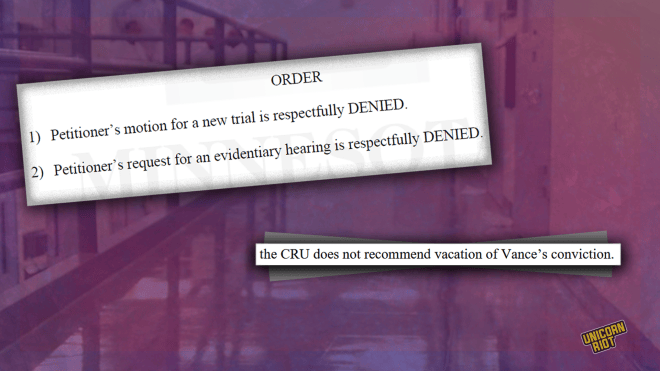
Last month was no different. Judge Michael Mayer denied Vance a new trial and an evidentiary hearing.
The ruling comes four months after Minnesota’s Conviction Review Unit (CRU) released their investigative report on Vance and “found a lack of reliable evidence to support Vance’s innocence claim” and concluded that they “cannot recommend vacation of his conviction.”
Vance’s support team told UR they’re appealing the latest denial. “We will continue to pursue every legal avenue available to ensure that Philip’s case is given the full and fair consideration it deserves.”
Coverage of Philip Vance’s ‘Wrongful Conviction’

Among the litany of issues Vance deems as reasons for his case to be heard again include errors by the trial court, errors by the prosecutor, ineffective assistance of trial counsel, ineffective assistance of appellate counsel, testimonial recantations, and that his case was investigated by the Minnesota Gang Strike Force, which was criminally disbanded years after Vance’s conviction.
Judge Mayer’s 19-page ruling on March 24 was in response to Vance’s legal team filing an amended version of his fifth petition for postconviction relief in February 2025, asserting that they had new evidence, that Vance was denied a fair trial, and that various court irregularities had occurred.
The denial order by Judge Mayer leaned heavily on the CRU’s final report on Vance, which was finalized in November and filed in district court on January 5, 2026. The report included over a thousand pages of supporting docs — view them in Unicorn Riot’s Vault Server.
Vance had submitted his application to the CRU on July 30, 2021, asking the unit to review his conviction. The CRU was formed earlier that year from a partnership between the Great North Innocence Project and the Minnesota Attorney General’s Office “to identify, remedy, and prevent wrongful convictions.” The underfunded unit accepted Vance’s filing and said they started investigating his case in August 2021.
Limited Funds Stunt Minnesota’s Conviction Review Unit — Families Want Expediency
After reviewing “thousands of pages of case-related materials, listen[ing] to hundreds of hours of recordings, and interview[ing] eight witnesses,” the CRU publicized their final report specifying its investigative findings.
The 112-page report essentially refutes each of the 12 points made in Vance’s application while noting they did find evidence of improper police work. “The CRU did not find Vance’s claims to be supported by evidence that is reliable and corroborated by other, independent evidence,” the report’s conclusion states.
“Although Vance’s legal team has identified some questionable tactics used by law enforcement in the Sabreen’s investigation, the CRU found his claim of innocence unpersuasive because it cannot be corroborated by credible evidence.” CRU Report on Philip Vance
In Judge Mayer’s denial he notes how important the CRU report was, saying that initially the court assumed “the assertions in [Vance’s] petition are true,” however, “it seems paradoxical that the court should assume as true facts that an independent agency (CRU), engaged at Petitioner’s request, already found to not have indicia of trustworthiness.”
Dakota County Attorney Kathy Keena, who prosecuted Vance’s murder trial in 2004, released a statement that read, “I respect the court’s decision and I appreciate the CRU for the thorough evaluation of this matter. Our office remains committed to transparency and to upholding the integrity of the justice system.”
Advocate for Philip Vance, Nikki Holliday, told UR, “This decision raises serious constitutional concerns, including violations of due process.”
“The State of Minnesota appears to apply exoneration standards inconsistently, even when similar errors and falsities exist. This inconsistency is deeply concerning and raises serious questions that cannot be ignored,” she said.
The petition was denied despite the legal team having “uncovered new material evidence the Conviction Review Unit never investigated,” noted Holliday.
Vance’s CRU report was the fourth investigation finalized and publicly released by the CRU out of over a thousand-plus applications they’ve received.
The unit had previously recommended vacated convictions for three men serving life for murder in the state, Thomas Rhodes, Brian Pippitt, and Edgar Barrientos. The cases went through different forms of litigation after CRU’s investigative report was filed but all three have since been released from prison, though it took Pippitt more than a year and a half after the CRU report because Aitkin County continues to fight the case in court.
Vance, who faced retaliation by prison officials for his role in a prison protest in September 2023, previously told UR that when he applied for the CRU he believed in the unit. But after waiting for so many years for the investigation on his case to be completed, among other reasons, he felt the unit had become “a joke.”
As Vance serves life, currently housed in MCF-Rush City, he hasn’t given up hope that he can get his case heard again in court. His support team said the “failures” of previous rulings “are now central to the appeal as we fight for a full and fair review.”
Originally published with Unicorn Riot on April 21, 2026.

