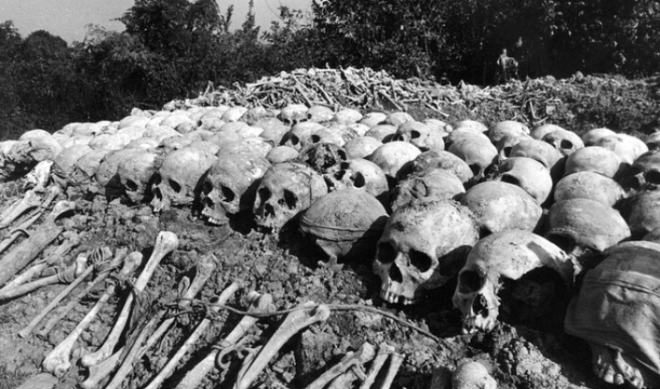
I chose to share this because of the recent sentencing of Khmer Rouge members for their roles in the Cambodian Genocide.
This post is an Eyewitness Assignment for a Information Studies: Genocide & Holocaust class at a University. Had this been a paper that I wrote without the parameters of the professor I would have shaped it a little different but points aside, there is pertinent information in this.
Cambodian Genocide
Background
The Communist Party of Kampuchea, known in the West as the Khmer Rouge, took over Cambodia in 1975, amid an extended crisis from external forces as well as a five year civil war. For the next three plus years, Cambodian society went through one of the most revolutionary transformations in history under Saloth Sar, also known as Pol Pot, who took to eradicating the old order and establishing a classless, rural, agrarian-based society, banning private property, money, and religion. “The goal of the new regime was to initiate a social, cultural, and economic revolution that would bring about a racially pure, self-sufficient, and socially and economically egalitarian Khmer society, without any Western technology or aid” (Welaratna). Pol Pot was “unlike most other revolutionaries” in his zest for cleansing the country from the existing order and foreign elements (McWilliams & Piotrowski 219).
The Cambodian people were forced to abandon their lives and move to collectivized agrarian work camps as “Pol Pot’s ideal was to create a nation of workers and peasants who would modernize industry and agriculture” (McWilliams & Piotrowski 219). This ideal, as well as viewing urban areas as representations of Western influence, exploitation, and capitalism, however grandiose, unfortunately led to the demise of the cities along with millions of ordinary citizens. Building on similar Communist plans that went awry like Stalin’s collectivization in Ukraine and the Great Leap Forward by Mao in China, the Khmer Rouge regime’s radical reforms produced endless deaths at forced labor camps from over working, starvation, diseases, and being tortured and or executed. While the exact tally of victims ranging from as low as 700,000 to upwards of 3.3 million, the facts remain that in a country as small as Cambodia, possibly over 25% of the population perished from this regime’s almost 4 years in power (Ringer). The survivors of this genocide were scarred for life and have plenty of grisly stories to tell.
Synthesis
The 1960’s and 70’s brought with it turmoil of foreign imperial conquests and Communist insurgencies in Indochina. During the 5 years of civil war in Cambodia preceding the Khmer Rouge takeover, a lot of Cambodian citizenry had family members fighting on both sides. In 1975, Mardi Seng had her father return after fighting the Khmer Rouge and then on “April 17, 1975, two weeks after my family was reunited, the Khmer Rouge toppled the Lon Nol Regime. On that same bright, warm, glorious and victorious day, a new era not of peace and tranquility, nor of hope and prosperity but of suffering, torture, hunger, diseases, work camps, reeducation, and systematic killing began” (Seng). She seems to spell out the sad spectacle of the new regime quite well.
The pictures of the skulls from the Pol Pot era in Cambodia are still on display decades later and are harrowing. The hardships that the survivors were made to endure during the Khmer Rouge reign is beyond frightful. One extremely common factor of the eyewitnesses and survivors accounts from the Cambodian genocide is the horrific psychological and emotional damage that it caused the victims and the population of the country on the whole. “The Khmer Rouge regime not only traumatized millions of Cambodians’ psychological function but it created a permanent scare in every Cambodian citizen” (Chanto). From the first day in power, psychological stress came upon the citizenry. On “April 17, 1975, the Khmer Rouge began evacuating and emptying people from all of the cities and towns in Cambodia. They told the people that the Americans would drop bombs in the city, so everyone had to leave” (Seng). The endless marches out of the cities were disastrous for the citizens as thousands and possibly hundreds of thousands perished. “I saw people committing suicide by hanging. It was a choice of killing themselves or killed by the Khmer Rouge. Many people simply felt that it was better to end their lives sooner than to be suffering. The terror and dreadfulness of the Regime was only beginning” (Gemza). A few years later Mardi Seng’s family exemplified the psychological stress as they came across a house while searching for food and in the living room was a “family of five lying there–dead…We walked out and joined other people in the yard. People’s reaction to this barbarous scene was not one of shock and horror but of casualness and coolness” (Seng). Coping through this ordeal created a disaster inside of the disaster itself, like past genocides, holocausts, political purges, or dictatorial agendas, the people were left to survive on their own will power and strength.
The stories from the collectivized work camps carried similar horrific tones among some of the survivors. When speaking of his experience, one survivor Ranachith Yimsut says, “We have always known that it was a “processing center.” It was also a place where people got punished or even executed for a minor infraction. They called it a “Work Camp”, but we all knew it simply as “Death Camp”” (Yimsut). After being separated from their families, large amounts of citizens, adults as well as children, were put to work doing hard labor in agricultural fields and building dams. Samnang Shawn Vann provided a small touch of the reality of overworking in the labor camps; “each day, I slept at least one or one hour and a half which is the most. I always work from one or twelves mid-night until eleven mid-night depending on their time… I work like an animal during a hot sunny day which the temperature sometimes reached up to 120 degree. There is never a single day or time that I have to rest in peace” (Vann). Another survivor remembers “in 1975, when the Khmer Rouge took power, we were forced from our home to live in the countryside. We lived in a hut, with little food to eat. I asked to be a seamstress in our commune, but sometimes I was required to farm. Since there were no shoes issued by the Khmer Rouge, my feet were bloodied by the ground” (Sou). While in the work camp “many died in front of me from heat stroke, sickness, exhaustion and starvation. But most died from beating they received from the soldiers” (Yimsut). The survivors’ memories of the labor camps are filled with tales of sleep deprivation, lack of food and water, and improper working conditions and hours that led to countless deaths.
The last major similarity among survivors that sums up the atrocities’ ugliness is the randomness of who was executed. “When we arrive there, they plan to execute us all…The Khmer Rough {Rouge} killed not just scholars, farmers, teachers, monks, men, elder, women, but they’re also killed babies and animals” (Vann). From the testimonies killings happened for some of the smallest reasons, like not moving fast enough, not handing over property, or like a survivor says “my sister-in-law lost a young sister who was jailed for stealing a corn from the field. Her sister was imprisoned and was later executed with many other prisoners who were jailed for minor offenses. They were all buried in mass graves” (Gemza). The methods of killing were particularly gruesome, “Axing and clubbing people to death was a system that the Khmer Rouge used because they did not want to waste ammunition” (Gemza). The dead were buried in mass graves, if they were lucky enough to be buried at all. For historical perspective, although the killings seemed indiscriminate, the perpetrators used the purpose of transforming society as an excuse, “classes were to be transformed, and if they resisted they would be exterminated…Pol Pot and the Khmer Rouge directed their fury against the old order, the Western-educated elite, city dwellers, and all real or suspected “enemies” of the revolution” (McWilliams & Piotrowski 219). A survivor states “the Khmer Rouge began to murder people such as generals, soldiers, lawyers and doctors, teachers, singers, actors, and the wealthy. They were condemned because it was said that such people had lived easy lives” (Suching). The overarching process of killing that the Khmer Rouge used was dramatic and hard to swallow, to hear the details make the reality all the more concrete.
Details
From leaving their lives behind and being forced into work camps, internment camps, and torture centers, the average Cambodian citizen was made to endure these struggles mostly separated from their families. “In order to have total control over the people, the Khmer Rouge utilized segregation. They broke up family units to weaken family ties and indoctrinate the people in their own thinking. By segregating the children, the Khmer Rouge was able to brainwash them” (Gemza). Survivor Soy Gemza recalls running away from her forced dwellings in the children’s hut to where her parents were staying and “as expected, I was caught and forced back numerous times. My parents were almost imprisoned for trying to protect and nurture me” (Gemza). To be a child enduring such hardship is unspeakable; the indoctrination, the loneliness, the terror, and the endless questions must have made it an especially tough experience.
Another startling survivor’s reality was that “the Khmer Rouge forced us to live in fields where there were no dwellings. We had to build our own homes, although many people did not know how to do this. There was no wood provided. We had to go to the forest, cut the wood or bamboo, and gather branches and leaves to cover the walls and roof” (Suching). Upon reading this testimony I’m left envisioning either a startling lack of foresight or a complete creation of a destructive order for the citizens with the Khmer Rouge forcing millions of families out of the cities into the countryside with no plan on long term health of those families.
The most harrowing survivor’s story that I personally read was that of Ranachith Yimsut’s “The Tonle Sap Lake Massacre”. His tale, which I have quoted parts of, is featured with a compilation of eyewitness accounts in the book Children of Cambodia’s Killing Fields: Memoirs by Survivors. The details in which he recalls surviving the massacre at Tonle Sap Lake are riveting and hideous. After waking up alive from being knocked out by clobber strokes, at the scene of a massacre, he recalls thinking “I am alive! Why? I could not understand why I was still alive and suffering. I should have been dead. I wished then that I was dead like the rest of people laying there…my cry turned to a sob and it was the only sound around beside the mosquitoes which continued to torment my almost bloodless body. I began to fade and feel as though my life was slipping away. I passed out again on top of the dead bodies” (Yimsut). Fortunately for him, he escaped through the jungle and lived to tell the story. Though he is “still a walking emotional wounded that need to be healed”, he finds it important to tell the story to help with the healing process (Yimsut).
Reflection
The Digital Archive of Cambodian Holocaust Survivors website showcases eyewitness testimonials of victims of Khmer Rouge’s brutal reign from April 17, 1975 through January 7, 1979 (Chandler). The accounts of survivors accentuate details and situations that aren’t normally conceivable by simply studying the subject. The immaculate descriptions of survival among massacres, escaping by chance, a school turned prison, and even getting revenge from the jungle are all viewable from this historically informative website. The specifics of the realities of everyday life under the regime, the separation from families, the struggle to eat, the life at the work camps, the dying and the dead, the ways of death, living through it all, escaping to Thailand or Vietnam and to the United States, the madness that their eyes saw and memories hold, are all presented in these testimonials.
My prior knowledge of this subject was purely of the political overture. I knew that during this time period the United States was on its way out of Indochina after suffering a massive defeat and being involved in several destructive wars, but they succeeded in carpet bombing as much area as they could. I knew a little about the Communist presence in Indochina but I did not know of the lofty utopian ideals that the Khmer Rouge had and I knew nothing of their radical reform plans. The ideals of egalitarianism, anti-imperialism, and anti-capitalism stood tall and bold, bringing truth to the souls. Intellectually I was intrigued by the thought process of these ideals. Yet, the realities of transforming all of society in a brief time, of eradicating the old order, of forcing citizens to labor camps, and of massive executions, that followed it were purely brutal and evil in nature. The maddening part of the Khmer Rouge reign was the destruction of its own people, to simply destroy the Westernized portions of the cities, class system, and capitalist banking system is one thing, but when you destroy the people who have to live within it, then the destruction becomes unspeakable. I found that the realities of these witnesses help us see the destruction that this regime brought with it. I wish I could say some optimistic words like “one day, humans will forever live in peace”, but the certainties are concrete and the ancient phrase “peace in the Middle East” will never die-off as we see active phases of genocide happening in this moment in the occupied territories of Palestine as well as various other locations throughout the globe. While we all pray for peace, Cambodian survivor Mao Hiet says “I {guess} this is what you call population control” (Hiet).
Works Cited/References
Ayres, David M. “Phnom Penh Evacuation.” Encyclopedia of Modern Asia. Ed. Karen Christensen and David Levinson. Vol. 4. New York: Charles Scribner’s Sons, 2002. 519. Gale Virtual Reference Library. Web. 20 July 2014. http://go.galegroup.com/ps/i.do?id=GALE%7CCX3403702360&v=2.1&u=mnamsu&it=r&p=GVRL&sw=w&asid=55a14942d570fb837921fcaea3ee5852
Chandler, David. “Genocide and Crimes Against Humanity: Cambodia.” Encyclopedia of Race and Racism. Ed. Patrick L. Mason. 2nd ed. Vol. 2. Detroit: Macmillan Reference USA, 2013. 227-231. Gale Virtual Reference Library. Web. 20 July 2014. http://go.galegroup.com/ps/i.do?id=GALE%7CCX4190600200&v=2.1&u=mnamsu&it=r&p=GVRL&sw=w&asid=ea48b00870e94b107fc1eba94ac6a8de
Miranda Twiss. The Most Evil Men and Women in History. London: Michael O’Mara Books, 2002. Print.
Welaratna, Usha. ““The Killing Fields”.” Encyclopedia of Asian American Folklore and Folklife. Ed. Jonathan H. X. Lee and Kathleen M. Nadeau. Vol. 1. Santa Barbara, CA: ABC-CLIO, 2011. 202-204. Gale Virtual Reference Library. Web. 20 July 2014. http://go.galegroup.com/ps/i.do?id=GALE%7CCX3301000091&v=2.1&u=mnamsu&it=r&p=GVRL&sw=w&asid=9e8742cf69227791e429b2b361e482f3
Wayne C. McWilliams & Harry Piotrowski. The World Since 1945: A History of International Relations. Boulder: Lynne Reinner Publishers, 2001. Print.
Ringer, Greg. “Killing Fields.” Encyclopedia of Modern Asia. Ed. Karen Christensen and David Levinson. Vol. 3. New York: Charles Scribner’s Sons, 2002. 368-370. Gale Virtual Reference Library. Web. 20 July 2014. http://go.galegroup.com/ps/i.do?id=GALE%7CCX3403701608&v=2.1&u=mnamsu&it=r&p=GVRL&sw=w&asid=69d52502e1434f51e4f417673e355122
Seng, Mardi. “A Spirit of Survival.” The Digital Archive of Cambodia Holocaust Survivors. Cyber Cambodia. n.d. Web. 20 July 2014. http://www.cybercambodia.com/dachs/stories/mardi.html
Gemza, Soy. “Cambodia: Genocide” The Digital Archive of Cambodia Holocaust Survivors. Cyber Cambodia. n.d. Web. 20 July 2014. http://www.cybercambodia.com/dachs/stories/soy.html
Chanto, Sisowath Doung. “Sisowath Doung Chanto.” The Digital Archive of Cambodia Holocaust Survivors. Cyber Cambodia. n.d. Web. 20 July 2014. http://www.cybercambodia.com/dachs/stories.html
Yimsut, Ranachith. “The Tonle Sap Lake Massacre.” The Digital Archive of Cambodia Holocaust Survivors. Cyber Cambodia. n.d. Web. 20 July 2014. http://www.cybercambodia.com/dachs/stories/ronnie.html
Vann, Samnang Shawn. “Samnang.” The Digital Archive of Cambodia Holocaust Survivors. Cyber Cambodia. n.d. Web. 20 July 2014. http://www.cybercambodia.com/dachs/stories/samnang.html
Sou. “A Cambodian Refugee’s Story.” The Digital Archive of Cambodia Holocaust Survivors. Cyber Cambodia. n.d. Web. 20 July 2014. http://www.cybercambodia.com/dachs/stories/sou.html
“Suching’s Story: Childhood Lost” The Digital Archive of Cambodia Holocaust Survivors. Cyber Cambodia. n.d. Web. 20 July 2014. http://www.cybercambodia.com/dachs/stories/suching.html
Hiet, Mao. “Victims of War.” The Digital Archive of Cambodia Holocaust Survivors. Cyber Cambodia. n.d. Web. 20 July 2014. http://www.cybercambodia.com/dachs/stories/mao.html
 The Work of Niko G