July 25, 2013
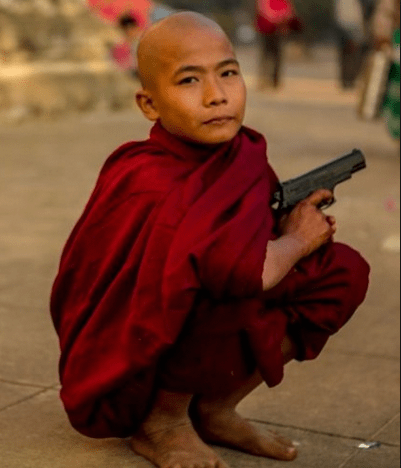
Buddhism has always been categorized as a peaceful and even pacifist religion. In its origins dwell a sacred ideal and “strict ethic of ahimsa (non-violence).”1 In this project, I will focus on Buddhism on the whole, not specific schools of Buddhism but Buddhism in general and how it relates to violence. With those opening two statements in mind, one must not look far to come across the reality that Buddhism emphasizes “non-violence and compassion for all living beings.”2 This has always been the stereotype and assumption that I would take while thinking of the Buddhist religion. While I draw the contrast of non-violence and violence within Buddhism, I recognize that a lot of motives for violence go beyond religion and specifically in highlighted cases, ethnicity plays a huge role, yet when violence is perpetrated by Buddhist leaders and monks, the controversy is illuminated.
It’s specifically stated in ‘A Concise Introduction to World Religions’ that a “characteristic of Buddhist political rule, was promotion of non-violence” and that “unnecessarily harsh punishments were forbidden and kings were expected to release prisoners during Buddhist festivals.”3 Yet “at the same time, the Buddhist king was expected to maintain an army and a police force, to defend the public against criminals and foreign enemies.”4 Peace was not always imminent, “territorial wars among various Buddhist kingdoms of Southeast Asia, and in Sri Lanka the conflict between the Buddhist Sinhalese and Hindu Tamils has a long history.”5 It is within this topic, that I will bring about the incredibly famous non-violent ethic and contrast it with what we see in modern day Sri Lanka and around Burma, where ethnic hatred and anti-Muslim ferver is rampant, even among practicing Buddhist monks.
As with other religions, people within the religion who do bad things shouldn’t make one view the whole religion in that same such capacity, as we see with the demonization of Islam by the media in America since nine eleven. Yet, upon learning of the realities that nationalistic Buddhist’s were/are at the forefront of some of the worst violence is shocking at the least. Believe it or not, because it is shocking to type, Radical Buddhism is a major player in Asia and its thriving.
Buddhist history on the island of Ceylon (Sri Lanka) dates back to the 3rd century BCE, when King Asoka’s son, who was a monk named Mahinda, brought Theravada Buddhism to the island and converted all Sri Lankans. The story is that Mahinda, along with his assistants actually tapped into their psychic abilities and travelled through the air to reach the island. The particular mood on the island was peaceful overall and there is a story of “a particularly pious king of ancient Sri Lanka” that “is remembered for instructing his staff to wake him even in the middle of the night if a citizen came seeking justice.”6 Sri Lanka was not able to fend off colonization in the recent past and finally gained its independence after 400+ years of Christian rule around 1948, as Burma did as well
Upon independence, Sri Lanka’s ruling party policies were heavily influenced by Buddhism and tailored to favor the Sinhalese Buddhist majority. “In the 19th century, many Buddhist Sinhalese felt that the British, who then ruled Ceylon (Sri Lanka), gave the Tamils preferential treatment. At independence in 1948, a disproportionate number of civil servants were Tamils. In 1956, the Sinhalese made swift and brutal amends.”7 Prime Minister Solomon Bandaranaike, who was a Catholic but also a Buddhist nationalist, took time “pampering the egos of the Buddhist bikkhus in his quest for power and position”and with this he “created significant change socially and ethnically in the political history of Ceylon (Sri Lanka).”8 He “launched a successful campaign to make Sinhalese the official language. He was heavily backed by the island’s monks in a move that excluded many Tamils from educational opportunities and prestigious jobs. In 1970, university admission rules were changed to favor the Sinhalese.”7 “This has led to feelings of oppression among members of the Hindu minority, most of whom are Tamils…Conflict between the government and the Tamil separatists seeking an independent homeland in the northern part of the island led to more than two decades of bloodshed, although Hinduism and Buddhism alike teach non-violence. The civil war finally came to an end in 2009 (technically), but relations between the two communities are still severely strained.”9
We start to see the infamous words of Thich Nhat Hanh come into focus: “The roots of war are in the way we live our daily lives-the way we develop our industries, build up our society, and consume goods.”10 The way that Sri Lankan and Burmese societies were broken down and built up with colonization created ‘the roots of war.’ When divisions and separations become norms, nationalism and xenophobia are victors and rapidly increase. Where does religion fit in? Because “the historical development of Buddhism in Asia shows its intimate connections with the ruling classes…Buddhists remember the reign of Asoka as the golden age of Buddhism, implying that the ideal of Buddhism is the establishment of a Buddhist state.”11 The deep and recent history of Sri Lanka is something to understand. The rift between the Sinhalese and the Tamil is an ethnic rift with implications that stretch far and morph itself into a religious issue.
Bringing Bandaranaike back into focus, he was assassinated by a Buddhist monk. This point brings up the controversy; Buddhism versus violence. “This year in Sri Lanka, Buddhist nationalist groups with links to high-ranking officialdom have gained prominence.”12 “Sri Lanka…has seen several Buddhist monks endorse religious hatred. In April last year, some joined the storming of a mosque claiming it had been built on sacred Buddhist land. Earlier, a nearby Muslim shrine was demolished by a crowd led by a monk.”13 These monks must not have been taught “for never does hatred by hatred cease: hatred ceases by love alone: this is an old law.”14 Instead these monks seem to be inspired by nationalistic and xenophobic means.
Time magazine recently ran a cover story titled ‘The Face of Buddhist Terror.’ In it, they profile Wirathu, aka the Burmese bin Laden, who “leads a movement called 969–the figure represents various attributes of the Buddha–which calls on Buddhists to fraternize only among themselves and shun people of other faiths. “Taking care of our own religion and race is more important than democracy,” says Wirathu.”12 Another description of 969 is their mission is “to shun companies owned or operated by Muslims, a small minority in the country but disproportionately concentrated in shops.” 15 “In Burma…the trouble began last year in the far west, where machete-wielding Buddhist hordes attacked Rohingya villages; 70 Muslims were slaughtered in a daylong massacre in one hamlet, according to Human Rights Watch. The government has done little to check the violence, which has since migrated to other parts of the country. In late March, the central town of Meikhtila burned for days, with entire Muslim quarters razed by Buddhist mobs after a monk was killed by Muslims. (The official death toll: two Buddhists and at least 40 Muslims.) Thousands of Muslims are still crammed into refugee camps that journalists are forbidden to enter.”12 Journalist Hannah Beech asked “Wirathu how he reconciles the peaceful sutras of his faith with the anti-Muslim violence spreading across his Bamar-majority homeland. “In Buddhism, we are not allowed to go on the offensive,” he tells me, as if he is lecturing a child. “But we have every right to protect and defend our community.””12 “There is no such thing in Buddhist scripture as a ‘just war’ of aggression, but many Buddhists have believed that a defensive war is not against dharma, and that the state may use force as necessary to maintain law and order.”3
I can understand the thought process of the ‘radical Buddhists’, it seems similar to that of Golden Dawn in Greece, they are xenophobic, un-liking of ‘others’, un-empathetic, and scared that ‘the others’ will get ahead of them in society. Take both Sri Lanka and Burma, Buddhists are the majority of the population and they see the influence of Islam rising while there is a possible need for reform within Buddhism to get the ‘wheel’ turning again. Yet I cannot condone their actions at all. We need more B. R. Ambedkar’s in this world, who “launched a movement for abolishing untouchability in India,” more crusaders “for the rights of the oppressed.”16 Like the legendary Thich Nhat Hanh says “we have to look deeply into the situation, and we will see the roots of war. We cannot just blame one side or the other. We have to transcend the tendency to take sides.”10 If one is to call the Muslims or the Tamils or whatever group, ‘the enemy’, then according to the Dalai Lama, one must practice patience and one’s merit will increase. His holiness admirably uses enemies as pawns in his kind life, saying “enemies are the main instigators of the increase of meritorious power. An enemy is not someone who prevents but in fact helps the practice of religion.”17
In closing, I would like to say as a child I never would have imagined that a person who follows Buddhism would be any sort of violent. Clarity comes with time, and as we live, we quickly see that no human is perfect and we cannot hold them to whatever beliefs they hold, and we cannot generalize a whole religion based on a few people because we all make mistakes. It seems like maybe Buddhists get the unfair stereotype of being perfectly harmonious when we are all instinctual and primordial beings that might have un-harmonious tendencies. Yet, the incredibly surprising violence and hatred spewed from religious men of Buddhist faith just creates a negative cycle…which is getting increasingly violent. Professor Satha-Anand, “from the Buddhist Philosophy department at Bangkok’s Chulalongkorn University,” wants “to know how the majority of Buddhists, who are pacifist, are going to respond to this? They should come out and say something. Otherwise people will think that this violence represents Buddhism, which it does not.”13 This situation is playing itself out on a daily basis, let’s hope peace for all, whether Royhinga, Tamil, Sinhalese, Bamar, Muslim, Hindu, Buddhist, or otherwise.
“My main motivation is a sincere feeling for others, and concern for others’ welfare.” The Dalai Lama
Works Cited:
1. Amore, Roy C. Concise Introduction to World Religions. Ontario: Oxford 2012. Print. Page 373.
2. Amore, Roy C. Concise Introduction to World Religions. Ontario: Oxford 2012. Print. Page 376.
3. Amore, Roy C. Concise Introduction to World Religions. Ontario: Oxford 2012. Print. Page 392.
4. Amore, Roy C. Concise Introduction to World Religions. Ontario: Oxford 2012. Print. Page 392.
5. Amore, Roy C. Concise Introduction to World Religions. Ontario: Oxford 2012. Print. Page 392.
6. Amore, Roy C. Concise Introduction to World Religions. Ontario: Oxford 2012. Print. Page 392.
7. Ridge, Mian. Buddhist Nationalism behind Sri Lanka’s Violent Surge. Christian Science Monitor. 18 June 2007. Web. 25 July 2013.
8. Rajasingham, K T. Sri Lanka: The Untold Story. Chapter 17: Assassination of Bandaranaike. Online Asia Times. 1 December 2001. Web. 25 July 2013.
9. Amore, Roy C. Concise Introduction to World Religions. Ontario: Oxford 2012. Print. Page 424
10. Nhat Hanh, Thich. Peace Is Every Step. New York: Bantom Books 1991. Print.
11. Mitsuo Kitagawa, Joseph. The World Treasury of Modern Religious Thought. Boston Toronto London: Little, Brown and Company 1990. Print. Page 353. 12. Beech, Hannah. The Full Text of the banned Time story ‘The Face of Buddhist Terror.’ Colombo Telegraph | Time Magazine. 3 July 2013. Web. 25 July 2013.
13. Martin, Nik. Violence in the Name of Buddhism. DW, 4 July 2013. Web. 25 July 2013.
14. Novak, Philip. The World’s Wisdom. Buddhism. New York: Harper Collins 1994. Print. Page 104.
15. Popham, Peter. ‘Buddhist Bin Laden’ Wirathu unharmed by car bomb attack in Burma. The Independent. 22 July 2013. Web. 25 July 2013.
16. Mitsuo Kitagawa, Joseph. The World Treasury of Modern Religious Thought. Boston Toronto London: Little, Brown and Company 1990. Print. Page 358
17. Lama, The Dalai. The Meaning of Life. Massachusetts: Wisdom Publications 1992. Print. Page 102.
 The Work of Niko G